Vermilion Flycatcher
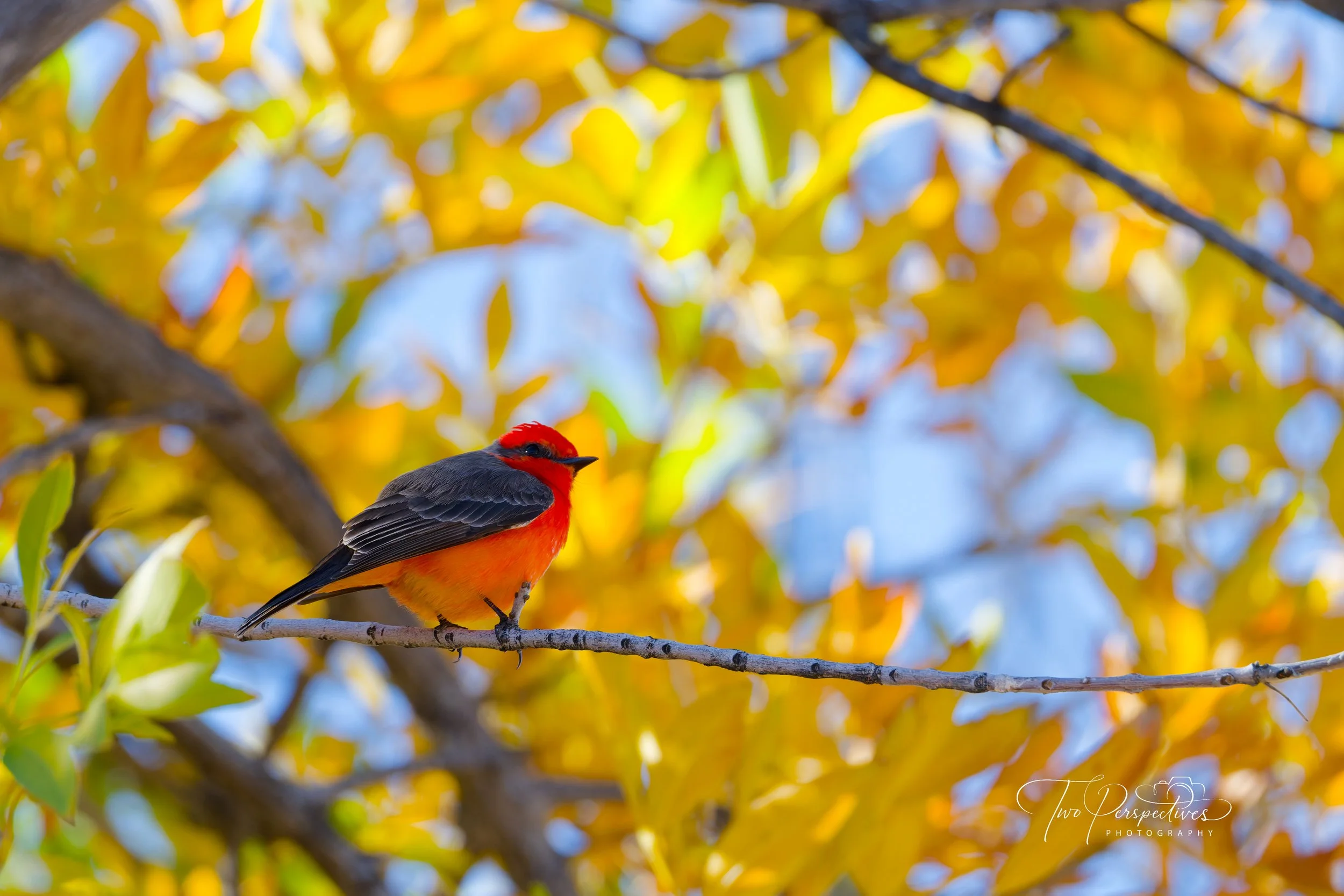
If you spend much time near water in the Tucson area, you will eventually see a small bird perched on a wire or exposed branch that looks like someone spilled red paint over a piece of coal. The male Vermilion Flycatcher is that kind of bird, the kind that makes you stop mid-stride and reach for your binoculars. He weighs less than half an ounce, and he is probably the most vivid thing in the landscape.
Performing above the desert
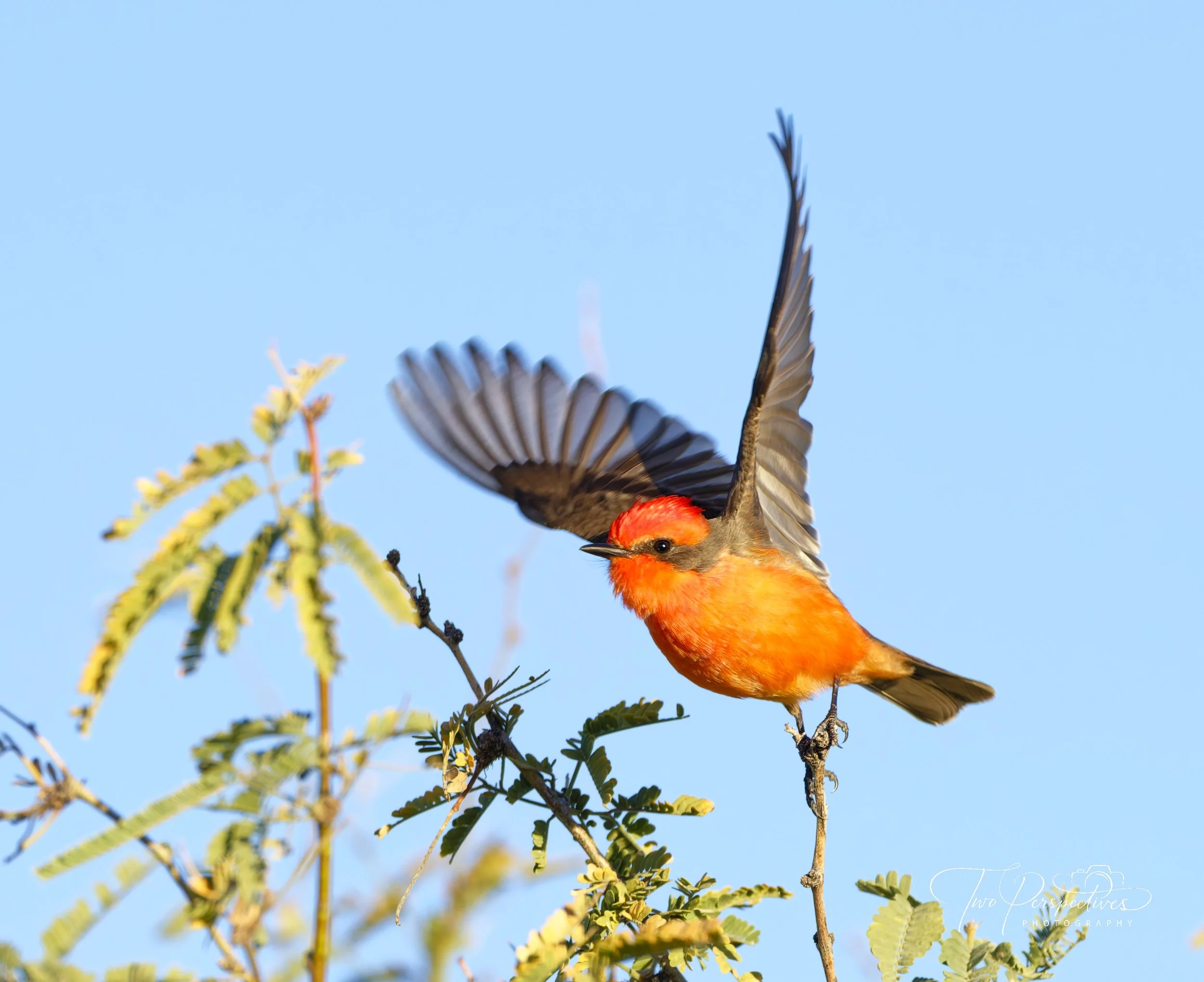
A male Vermilion Flycatcher does not sit quietly and wait to be noticed. During breeding season, he rises 60 to 100 feet above the surrounding vegetation in a slow, theatrical display flight, alternating gliding and shallow wingbeats while singing a bright, tinkling song. His red feathers puff out into a glowing ball as he climbs, then he swoops back down to his starting perch. The behavior is both territorial advertisement and courtship display, and if there is a female nearby, she will often join him to inspect potential nest sites once he lands.
Our wild neighbors
In the Tucson area, Vermilion Flycatchers are year-round residents in riparian corridors and any open green space with water nearby. Sweetwater Wetlands, Reid Park, and Agua Caliente Regional Park are all reliable spots, as are lower sections of Madera Canyon and stretches of the Santa Cruz River corridor. They prefer open ground near water, which makes them equally at home in city parks and along golf course ponds. They perch conspicuously, bob their tails constantly, and are not particularly bothered by people moving nearby. Arizona alone has more than 9,100 research-grade iNaturalist observations for this species, a reflection of how findable they are here year-round.
A few fun facts
Partners in Flight estimates the global breeding population of the Vermilion Flycatcher at about 15 million birds, and it is rated at low conservation concern.
The name "vermilion" refers to the vivid red pigment, historically produced from mercury sulfide, which comes close to matching the male's color.
Despite its striking appearance, this is a small bird, measuring just 5.1 to 5.5 inches long and weighing 11 to 14 grams, less than half an ounce.
Males bob their tails constantly while perched, a habit they share with phoebes and one of the fastest field ID clues for the group.
They capture most of their food in the air, flying out from a perch in short, looping sallies and returning to the same spot after each catch.
What they eat and how they hunt
Vermilion Flycatchers eat almost entirely insects. Their known prey includes beetles, flies, wasps, grasshoppers, honeybees, and crickets, along with many other flying insects. They typically hunt within about 10 feet of the ground, watching from an exposed perch and launching in a quick, looping flight to intercept prey in the air. Larger prey like grasshoppers or butterflies gets carried back to the perch and whacked against it a few times to subdue it before the bird swallows it. The indigestible parts, such as wings and hard exoskeletons, get coughed up later as small pellets, similar in principle to what owls produce, just on a much smaller scale.
Where and when to find them
Sweetwater Wetlands is probably the most reliable single spot in the Tucson metro for this species, and they can be there any month of the year. Reid Park and Agua Caliente Regional Park are both dependable as well. The Santa Cruz River corridor, when it has good riparian vegetation, holds them in good numbers. If you are heading south to Madera Canyon, watch the lower, wetter riparian stretches along the road in, before the main parking areas. Early morning is generally best for active foraging and display behavior, but because they perch in the open, midday sightings are common too. They are one of the few birds you can reliably find in a public park on a weekday lunch break.
Capturing them
Few birds in the Southwest offer as much photographic reward for the effort involved. The male's red-on-black contrast works beautifully against almost any background, green riparian vegetation especially. The ideal shot is a clean perch portrait with a simple, complementary background, or a male against a bright sky. Getting the display flight on camera is harder but worth pursuing in spring when males are actively performing. Give the bird enough space to stay relaxed and you will get more frames than you expect.
Next time in the series, we spotlight another one of the birds that makes southern Arizona worth stepping outside for. Until then, keep your binoculars ready.