If you have spent any time in the rocky canyons around Tucson, you have seen the rock squirrel. You may have just called it "a squirrel." That is fair. Rock squirrels are common, confident, and not especially shy, which means they get overlooked as background wildlife. But spend a few minutes watching one work a pile of acorns or square up against a rattlesnake, and you will start seeing this animal a little differently.

Not the squirrel you think it is
The rock squirrel (Otospermophilus variegatus, formerly Spermophilus variegatus) looks like a typical tree squirrel at first glance, but it is actually a ground squirrel, closer in biology to prairie dogs and ground squirrels than to the tree-climbing species most people picture. It belongs to a different genus entirely from the Arizona gray squirrel, which shares some of the same canyon habitat but lives a very different life. The rock squirrel burrows. It lives in colonies. It hibernates in the northern part of its range. In southern Arizona, where temperatures stay moderate enough year-round, it remains active year-round without hibernating.
It is also one of the larger members of its family. Adults range from about 430 to 540 millimeters in total length, close to 21 inches at the upper end, which makes them noticeably larger and chunkier than most people expect from something called a ground squirrel. Eight subspecies are recognized across the range.
What to look for
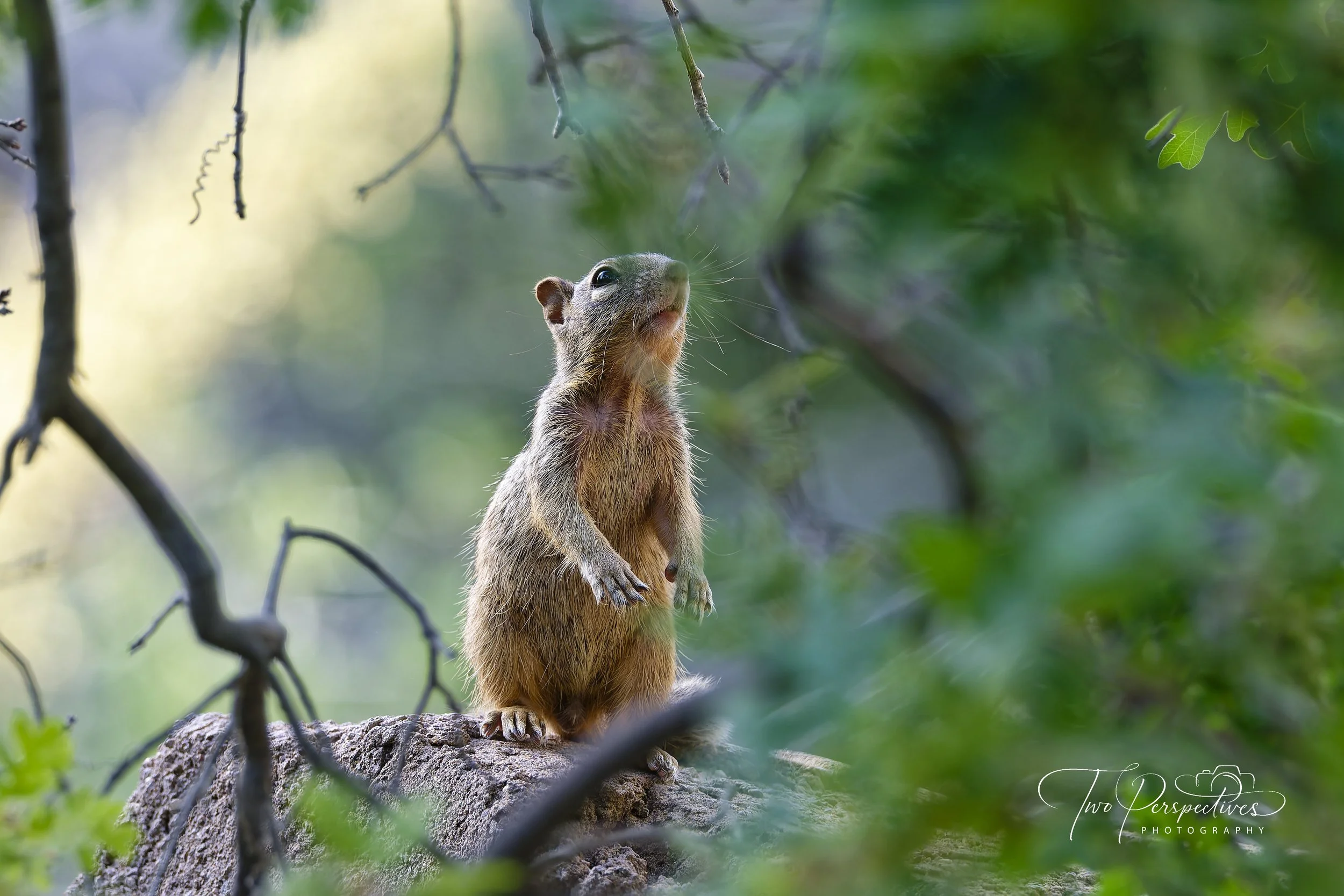
The rock squirrel's coat is speckled grayish-brown on the head and upper body, shifting to a more mottled grayish-black toward the rear. The underside is buff white to pinkish. The ears extend above the top of the head and are longer than wide, giving a noticeably upright ear profile. The tail is long and bushy.
When a rock squirrel is alarmed, it gives a short, sharp whistle, a call that carries well across rocky terrain. Once you learn that call, you will start noticing how often rock squirrels are quietly monitoring whatever is moving through their territory.
Built for the rocks
The name is literal. Rock squirrels prefer exactly what it sounds like: rocky canyon walls, boulder fields, cliff edges, talus slopes, and steep hillsides with broken rock and crevice cover. They dig burrows with muscular legs and sharp claws, typically positioning entrances beneath rocks where they are well hidden and difficult to reach for most predators.
Burrow systems grow in complexity over time. A typical burrow is short (0.3 to 1.5 meters) but can be excavated up to 5.8 meters long, with a main chamber, one to three outside openings, and a separate nesting chamber. Individuals usually maintain one home burrow and several foraging burrows throughout their territory. Burrow entrances are lined with grasses, bark, and leaves.
In southern Arizona, rock squirrels are common across the desert foothills and canyon systems. They are especially easy to find at places with good boulder cover and reliable food sources nearby: oak stands for acorns, canyon trails where human visitors leave things behind, and riparian areas with native fruit and seed plants.

Social structure
Rock squirrel colonies are organized around maternal aggregations at a group of dens, with one dominant male who defends the colony against other mature males. Subordinate or subdominant males exist at the outer edges of the group, tolerated but kept at a distance by the dominant animal. Juveniles and females come and go freely. This colonial structure appears in areas of high population density; in sparse populations, rock squirrels are largely solitary.
Breeding season in southern Arizona runs April through August. Most females produce one litter per year, though occasional second litters have been documented. Litter size runs from three to nine young, with an average of about 4.8. Young emerge late July through September.
Diet and food handling
Rock squirrels are true omnivores, and their diet shifts noticeably with the season. Early spring brings mostly green vegetation. Summer shifts toward berries and fruits. Fall is the time for grains, seeds, and nuts. Year-round, the diet includes seeds, acorns, pine nuts, mesquite, juniper berries, agave, and cactus fruit, along with insects including grasshoppers, beetles, and earthworms. Young wild turkeys and other small vertebrates have also been documented as prey.
The cheek pouches are impressive. One researcher counted 62 Gambel's oak acorns carried in a single squirrel's cheek pouches on one trip. Foraging trips typically last about 12 minutes, with most foraging concentrated in the morning to avoid the worst heat of the day. Food is eaten on the spot or hauled back to a lookout point or burrow entrance to be consumed or cached safely.
Rock squirrels can survive for extended periods without access to water; one study documented individuals surviving up to 100 days on dry food alone (Oaks et al. 1987, Mammalian Species 272).

Rattlesnake confrontations
This is the behavior that makes rock squirrels genuinely interesting to watch. When a rock squirrel encounters a snake, it does not simply run. It erects its tail and waves it from side to side, makes menacing movements toward the snake, and has been documented throwing dirt and debris at it. Sometimes the squirrel attacks the snake directly.
A closely related species, the California ground squirrel, has been shown to add an infrared component to its tail-flagging behavior when confronting pit vipers, warming the tail so that the snake's heat-sensing organs detect it as a threat signal (Rundus et al. 2007, PNAS 104(36):14372–6). Whether rock squirrels do the same has not been separately confirmed in peer-reviewed research, but the confrontation behavior itself is well-documented.
Adult rock squirrels also have blood serum that partially neutralizes specific components of rattlesnake venom, specifically the metalloprotease and hemolytic enzymes of prairie rattlesnake and western diamondback venom (Biardi & Coss 2011, Toxicon 57(2):323–31). This is not full immunity; it is evidence of an ongoing evolutionary arms race between these two species in the same rocky terrain, with the squirrel's blood chemistry adapting over time to the snake's weapon.
A few fun facts
With more than 7,900 research-grade iNaturalist observations in Arizona, the rock squirrel is one of the most frequently recorded mammals in the state.
Their winter coats grow noticeably denser. The density of guard hairs rises by about a third in the cold months to trap more warmth (Walsberg and Schmidt 1989).
They are a natural reservoir for sylvatic plague and host at least 19 species of flea, and they have also been linked to tularemia and Rocky Mountain spotted fever. That is the real reason to enjoy them at a distance and never feed or handle one.
Where and when to find them
Rock squirrels are not hard to find. Anywhere with rocky terrain and oak cover in the Tucson region is a reasonable starting point. Madera Canyon along the rocky lower slopes, the canyon trails at Catalina State Park, Sabino Canyon, and the boulder-heavy terrain of the Chiricahuas and Huachucas all hold consistent populations. They are active in the morning and again in the late afternoon, with a tendency to rest in shade during the hottest part of the day.
Canyon trailheads and picnic areas with rock outcroppings are reliable because rock squirrels are habituated to human presence in those spots and allow closer approach. Feeding them is not a good idea and is often discouraged or prohibited, as it creates dependency and carries real disease transmission risk given the species' association with plague and other pathogens.
Capturing them
Rock squirrels are one of the more forgiving subjects for wildlife photography in southern Arizona. They are alert but not panicked by humans at most trail locations. The challenge is not access but composition: boulder habitat tends to be chaotic, and getting a clean background behind the subject requires working the angle carefully.
Watch for them at burrow entrances in early morning. A squirrel emerging to the first light, perched on a rock, scanning its territory, is a compelling image. The tail-waving alarm behavior is easy to anticipate once you know the alarm sequence, and it often produces action. The snake-confrontation behavior is rare to witness, but rock outcroppings near known rattlesnake habitat are worth extended observation if you have the time.
Longer focal lengths help clean up busy backgrounds. Late afternoon light on reddish canyon rock makes for warm, flattering color when a squirrel is silhouetted or side-lit on a boulder.
A side note from Chloe
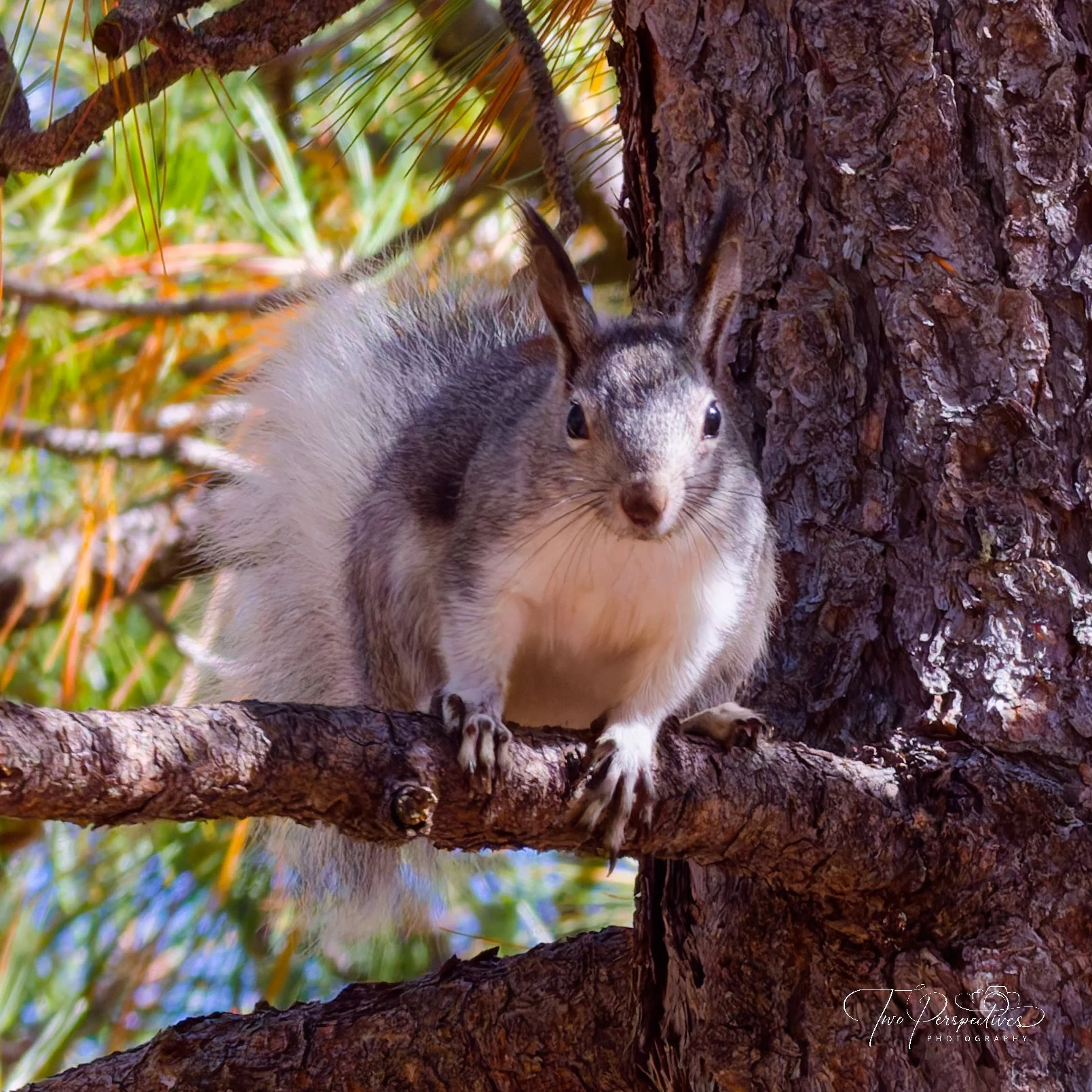
Yesterday, October 14th, was the one-year anniversary of the image that started all of this. I was still early in learning photography, and we were up on Mt. Lemmon. While we were up there, we happened upon an Abert’s squirrel. I got so excited that I did everything I could to grab as many frames as possible before it darted off through the treetops. That photo became the one that pushed me to pack years of photography into months, and it is what led to Two Perspectives Photography and Two Perspectives Wildlife.