The first time one crosses your path, you think the light is playing tricks on you. A big dark butterfly drifts low over a desert wash, wings mostly black, and then it banks into the sun and the hindwings flash a deep electric blue that seems lit from inside. That flash is how we usually spot a Pipevine Swallowtail out here, a slow, floating shimmer against the dry grass and rock of the southern Arizona desert. Get close, and the story only gets better, because this is one of the most thoroughly defended butterflies on the continent.
The blue that stops you
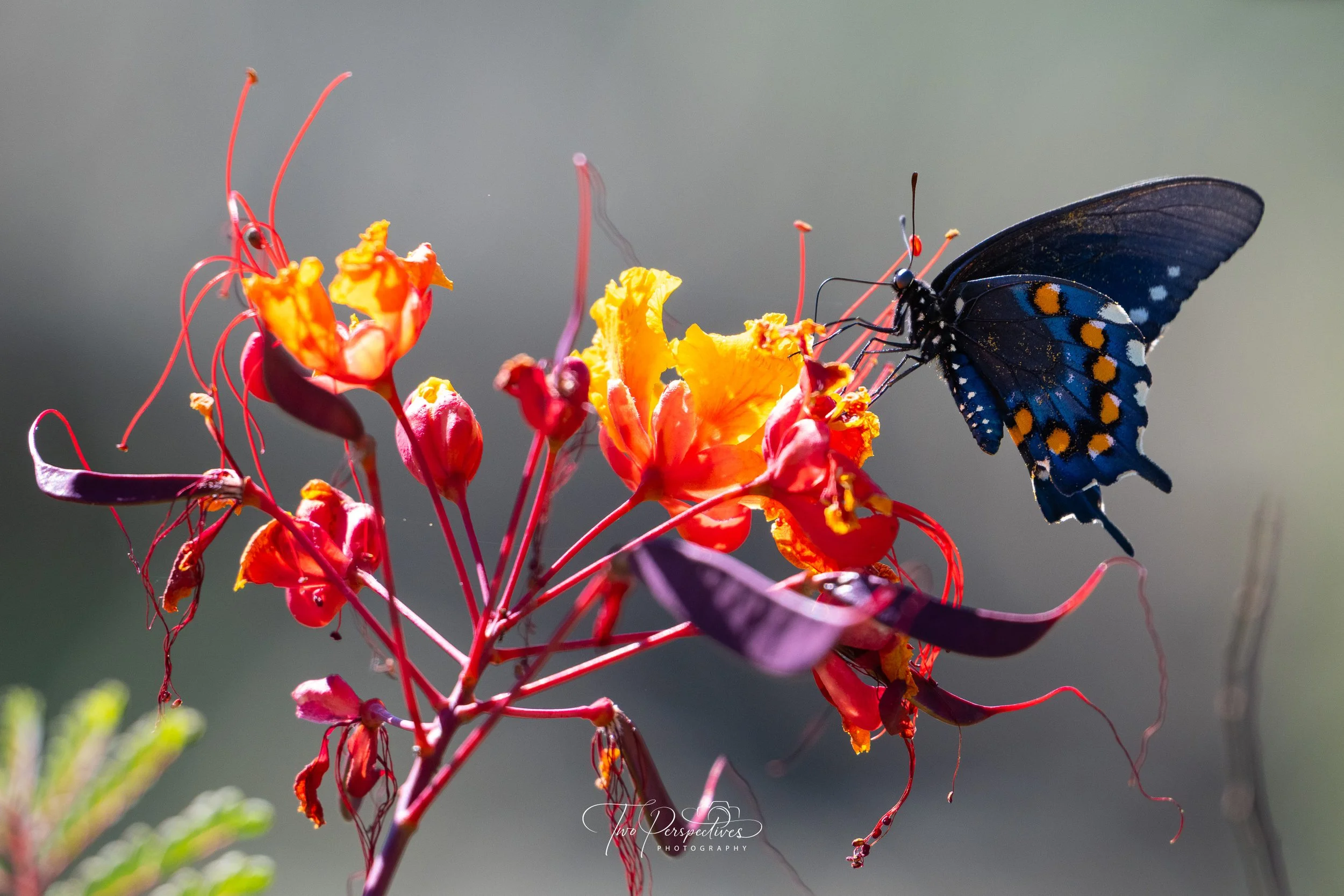
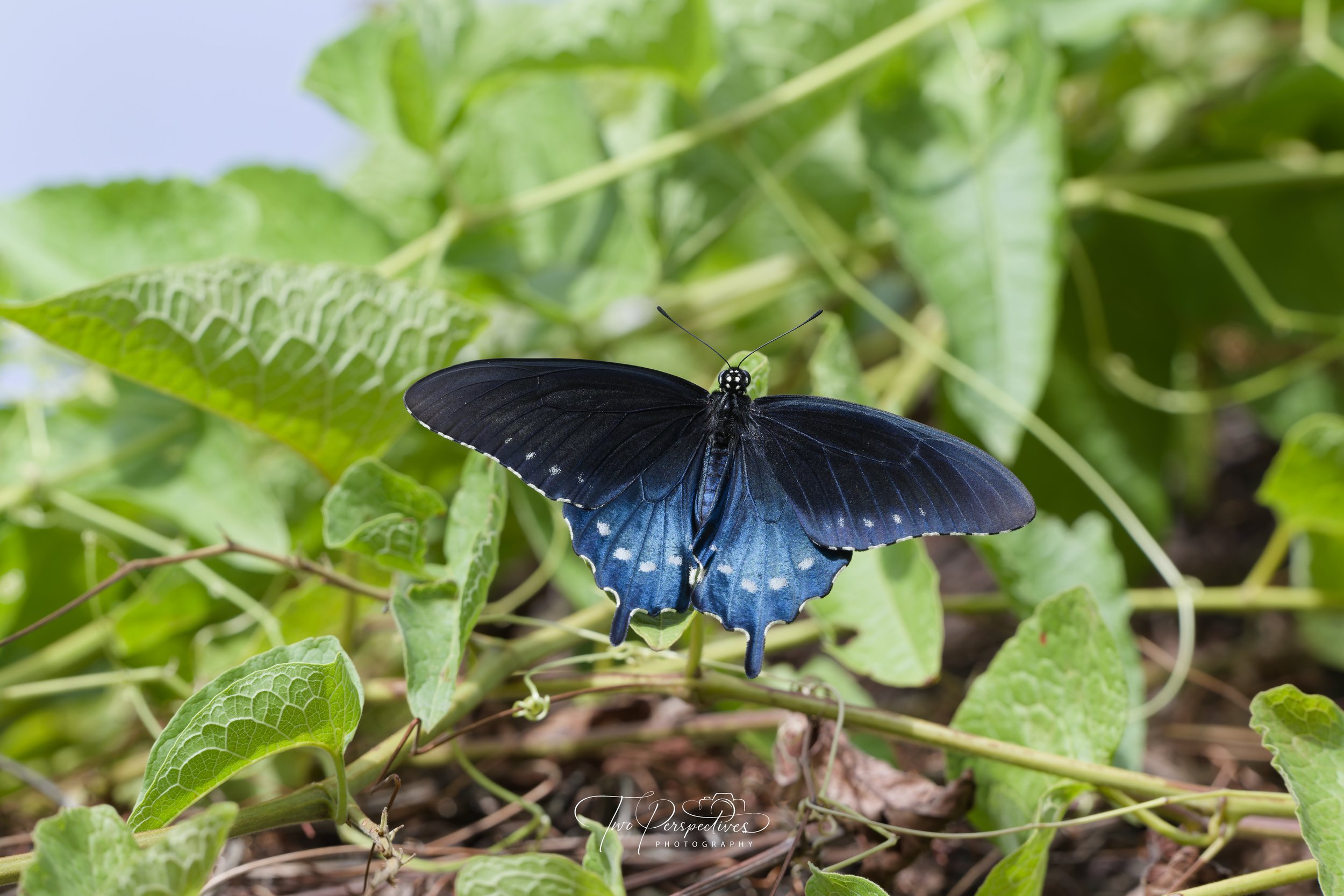
The Pipevine Swallowtail, Battus philenor (Linnaeus, 1771), belongs to Papilionidae, the swallowtail family. It is a large butterfly, with a wingspan running roughly 2.75 to 5 inches, so it has real presence in the air. From above, the wings are black to charcoal, with a wash of iridescent blue to blue-green spilling across the hindwings. That blue is a structural color, created by the microscopic architecture of the wing scales rather than by pigment, which is why it shifts and glows as the angle of light changes. The shimmer is strongest in males and more muted in females. On the underside of the hindwing you find the other signature, a single arc of seven bold orange spots ringed in black against that blue ground. Those orange spots are a warning, and they are honest.
Pipevines and a borrowed poison
Everything about this butterfly traces back to one group of plants. Its caterpillars feed on pipevines, plants in the genus Aristolochia, and here in southern Arizona the key native host is Watson's dutchman's pipe, Aristolochia watsonii, also called the southwestern pipevine or indianroot. It is a low, ground-hugging vine with arrowhead-shaped leaves and a strange, fetid little flower, easy to walk past unless you know to look.
The pipevines carry defensive compounds called aristolochic acids, which are toxic to most animals that try to eat them, and the Pipevine Swallowtail has turned that chemistry to its own advantage. The caterpillars eat the leaves and store the aristolochic acids in their bodies, and those compounds carry through to the pupa, the adult, and even into the next generation's eggs. The result is a butterfly that is distasteful and genuinely toxic to many birds and other vertebrate predators. The bright blue and the orange spots are aposematic coloration, a visual announcement that this is not worth eating. Researchers in Arizona have studied that iridescent blue specifically as a warning signal.
The model everyone copies
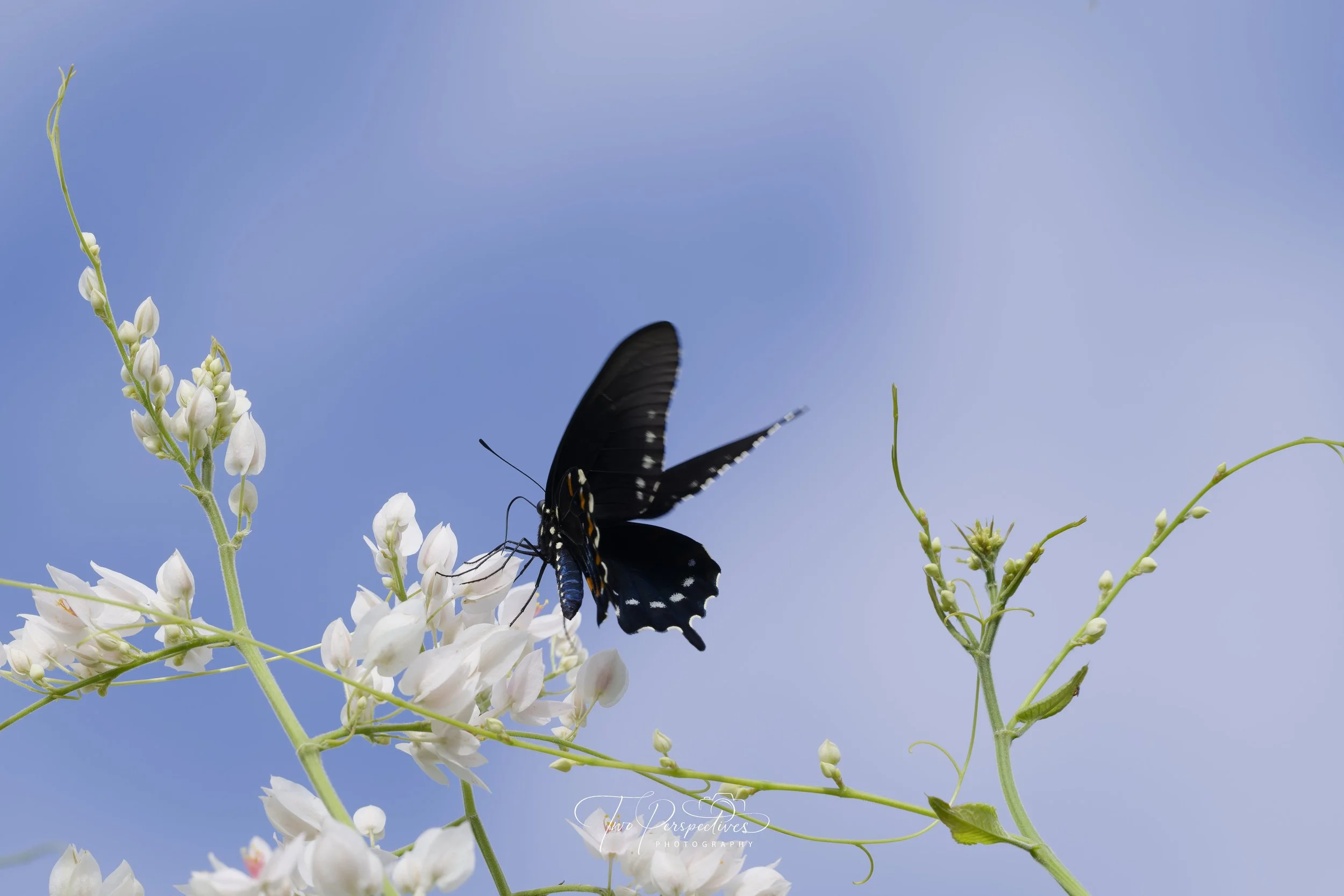
Because predators learn to avoid that distasteful blue-and-orange pattern, the Pipevine Swallowtail has become the template for one of the most famous cases of Batesian mimicry in North America. In Batesian mimicry, a harmless, edible species evolves to resemble a defended one and gets protection for free. The Pipevine Swallowtail is the model, the genuinely toxic original, and a lineup of other dark butterflies imitate its look, including the dark female form of the Eastern tiger swallowtail, the black swallowtail, the spicebush swallowtail, and the red-spotted purple. We keep our focus on the real deal here, but learning this one butterfly hands you the key to a whole crowd of look-alikes.
From red eggs to floating adult
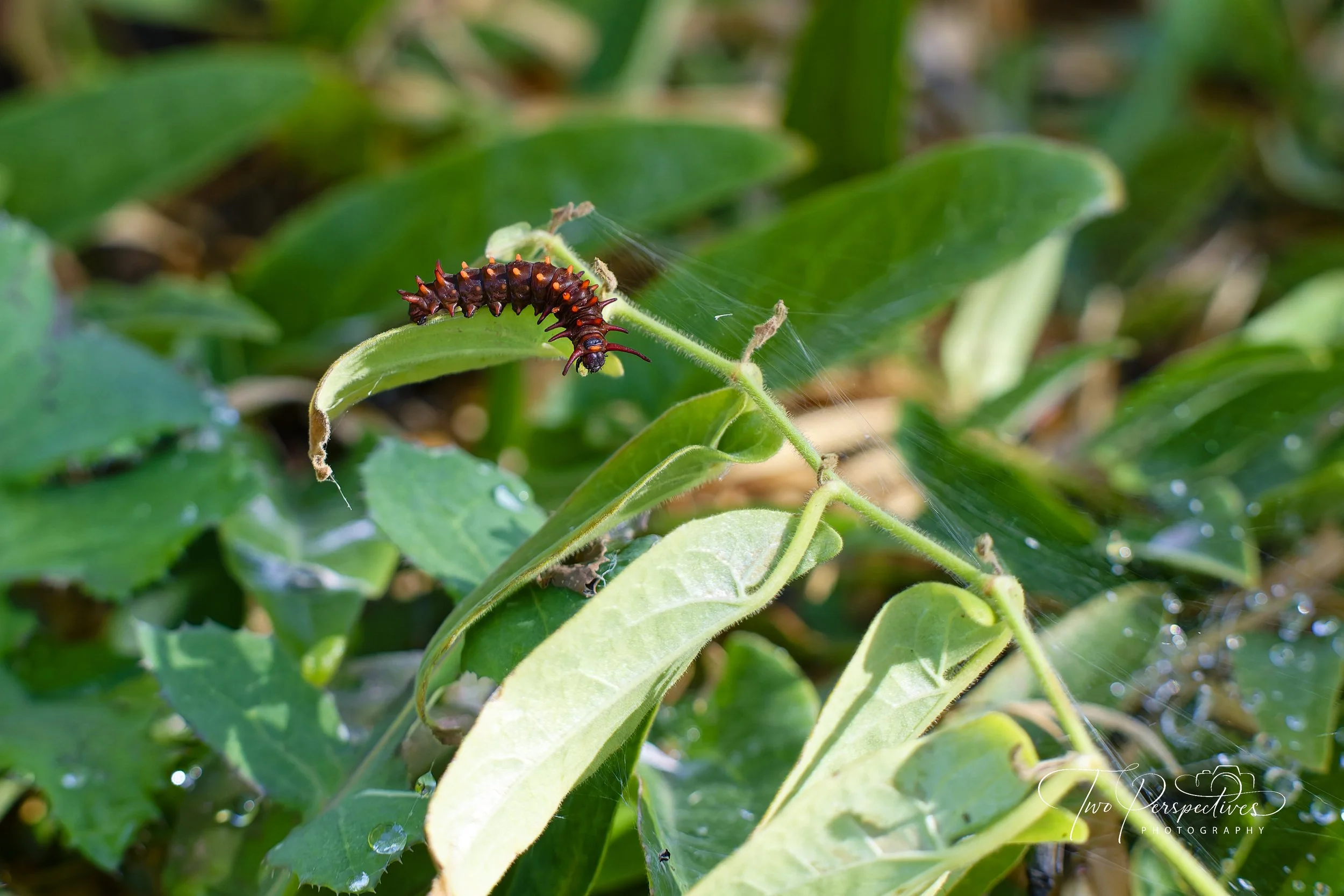
The life cycle plays out right on and around the host plant. Females lay small clusters of reddish-orange eggs on pipevine leaves and stems. The caterpillars that hatch are striking in their own right, velvety black to dark brown and studded with rows of fleshy red-orange tubercles, reaching about two inches when full grown. Like other swallowtail caterpillars, they carry an osmeterium, a fleshy organ that everts from behind the head and releases a pungent smell when the caterpillar is bothered. The chrysalis can be green or brown. In our warm climate the butterfly produces multiple generations through the year, so the stages overlap and you can find eggs, caterpillars, and adults across a long season.
A southern Arizona regular
The Pipevine Swallowtail ranges across much of the eastern and southern United States, reaching west to Arizona, and it is a familiar sight here in the Sonoran Desert where its host plant grows wild. Its conservation status is secure, so this is a species we can simply enjoy, while remembering that the butterfly only persists where its pipevine does.
A few fun facts
The genus name Battus honors Battus I, founder of the ancient Greek colony of Cyrene in North Africa, and the species name philenor comes from Greek for "fond of husband."
The species is also known as the Blue Swallowtail.
Southern Arizona's native host, Aristolochia watsonii, was known locally as indianroot and used as a snakebite remedy by Native peoples and early settlers.
Where and when to find them
Look for Pipevine Swallowtails wherever their host plant grows, which in southern Arizona means desert washes, rocky hillsides, canyon riparian corridors, desert grassland, and planted spaces that offer native pipevine or good nectar. Public gardens that grow host and nectar plants, such as the Arizona-Sonora Desert Museum, Tohono Chul, and Tucson Botanical Gardens, along with home yards planted with Aristolochia watsonii, are reasonable places to encounter them, though we would rather point you to the habitat than promise a specific bench. On iNaturalist, Arizona carries roughly 5,490 research-grade observations of the Pipevine Swallowtail, with the native host plant logging around 1,032, enough to confirm this is a well-established resident. Those records suggest the butterfly is active across much of the year, with a spring uptick and a strong showing in late summer and early fall. One caveat, observation counts partly reflect where and when people are out looking, so treat the pattern as a guide rather than a timetable.
Capturing them
The first rule with a Pipevine Swallowtail, and really with any pollinator, is that chasing never works. You cannot follow a butterfly, a hummingbird, or a bee around and expect a sharp frame. You let them come to you. Find where they are actually feeding, then set up on a spot where you can see several blooms that have clean backgrounds and good light, and settle in to wait.
The real trick is to be ninety-five percent of the way to the shot before the butterfly ever lands. Have your exposure set, your focus close, and your composition already chosen, so that when one drops onto a flower you only make the last small adjustment and fire. Most pollinators do not sit still, and a Pipevine Swallowtail feeds in a restless, fluttery way, so you often have only a second or two before it lifts off again. A fast shutter catches it clean in that narrow window.
A couple of things reward the wait. That signature blue is iridescent, coming and going with the angle of light, so position yourself relative to the sun until the flash ignites, and keep your shadow off the insect. Soft early or late light brings out the color without blowing out the shimmer. And for something completely different, a patch of pipevine can hold red eggs, bold caterpillars, and a chrysalis all at once, the whole life story on one small vine, and that subject holds still for you.