Great Horned Owl
Before the desert has fully committed to night, when the sky still holds the last pale blue of dusk and the saguaros are becoming silhouettes, the Great Horned Owl begins. That deep, resonant hooting, a few slow, measured notes drifting across the wash, is one of the most primal sounds the Sonoran Desert makes. It isn't subtle and it isn't soft. It lands in the chest. And the bird behind it, perched on a prominent snag with those ear tufts outlined against the fading sky, is every bit as commanding as the voice.
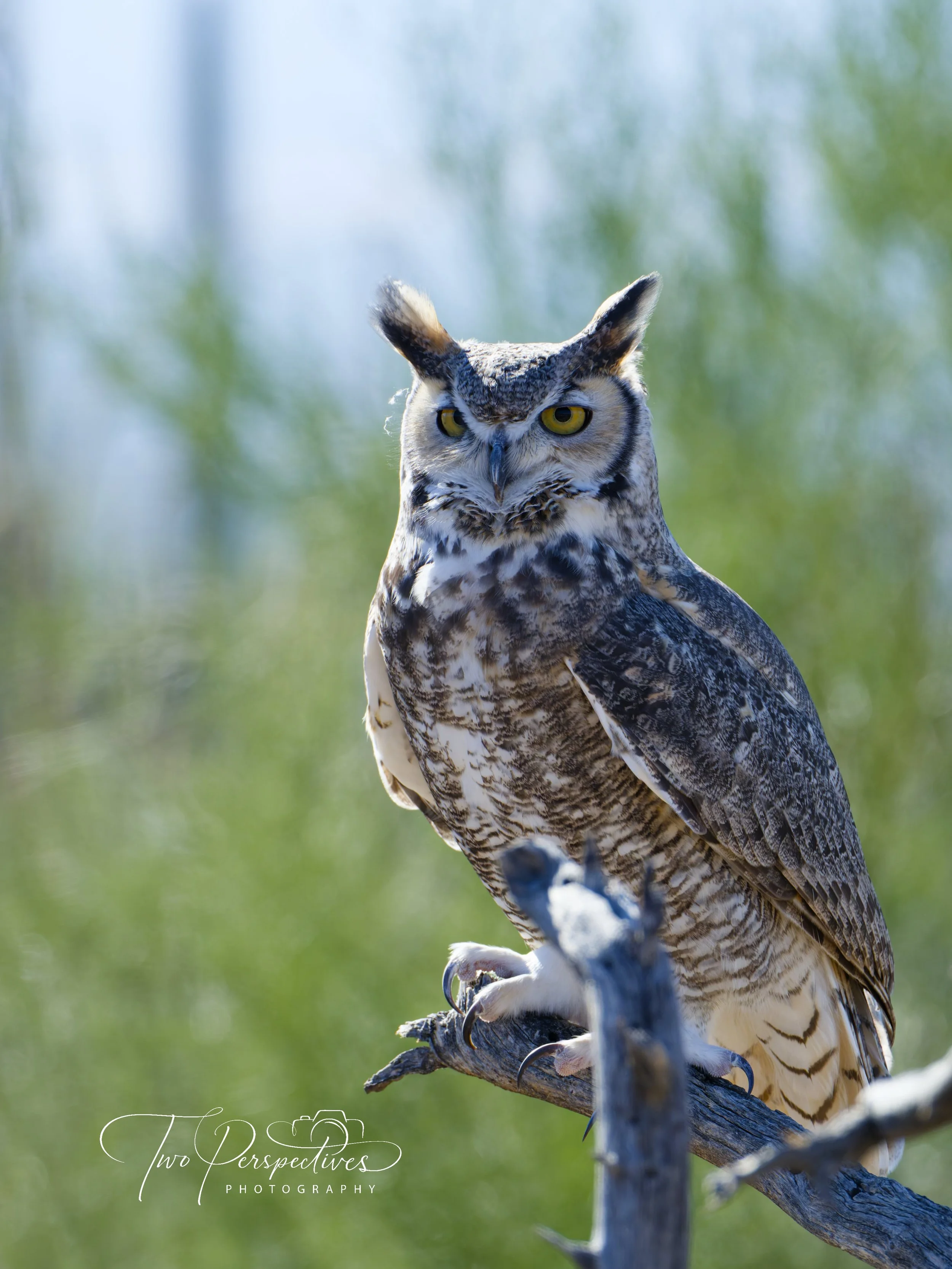
The desert's apex predator of the night
The Great Horned Owl earns its reputation. As one of the largest and most powerful owls in North America, it sits at the top of the nocturnal food chain and operates accordingly. It takes prey as large as rabbits, skunks, and other raptors, including hawks and smaller owls, and has even been documented taking young great blue herons from their nests. The talons are the instrument: gripping strength that rivals a much larger bird's, capable of killing prey nearly as heavy as the owl itself. Those "horns," by the way, are not ears at all, they're feather tufts with no hearing function, widely believed to help with camouflage by breaking the bird's silhouette against bark and branches.
Our wild neighbors
Few birds have adapted to as wide a range of habitat as the Great Horned Owl, and Tucson is a good illustration. Desert washes, saguaro flats, riparian corridors, golf courses, neighborhood parks, and the quieter edges of suburbs all host resident pairs. They don't build their own nests, they commandeer the nests of hawks, ravens, and other large birds, often occupying them while the original owners are still using nearby territory. They're among the earliest nesters of any bird in the region, laying eggs in January or February when the desert is still cold, incubating through winter, and producing young well before spring migration begins. A female sitting tight on eggs in a stolen hawk nest in February, dusted with light snow, is one of the stranger and more beautiful sights a Tucson winter can offer.
A few fun facts
Great Horned Owls can rotate their head approximately 270 degrees, not all the way around, but close enough to see behind them without moving their body.
Their ears are asymmetrically placed on the skull, one higher than the other, which allows the brain to triangulate the exact three-dimensional location of a sound, enabling them to hunt by hearing alone in total darkness.
They have no functional sense of smell, which is why they're one of the very few predators that regularly hunt and eat skunks.
A mated pair typically maintains the same territory for life, returning to the same general nesting area year after year.
Their hooting is one of the most commonly misidentified bird calls, many people assume any hooting owl is a Great Horned, when the region hosts several species with completely different calls.
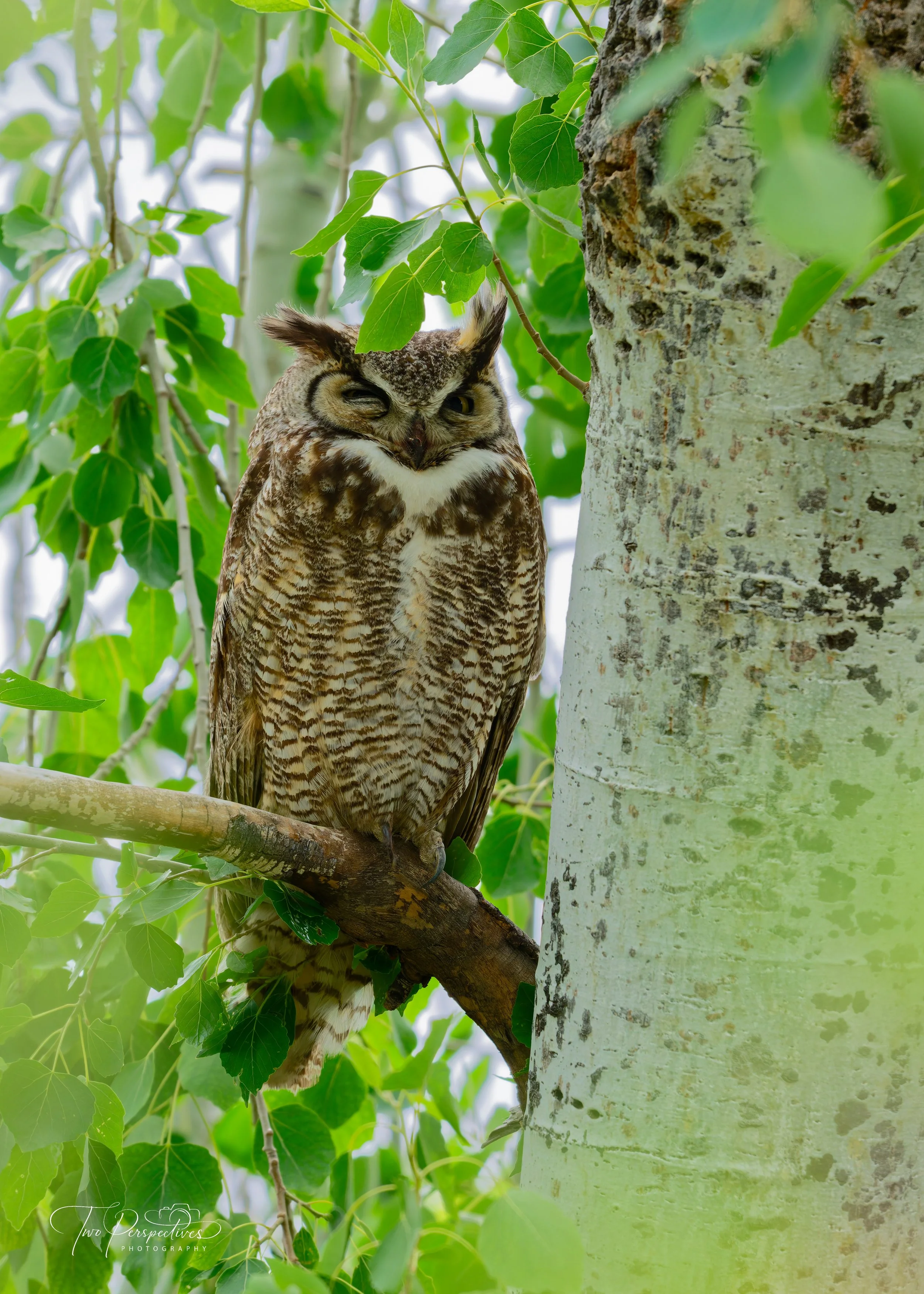
Where and when to find them
Year-round throughout the Tucson area, with peak vocal activity from November through March during the breeding season. Dusk is the prime time, listen for the hoot and scan the high, exposed perches: snags, saguaro tops, utility poles, and the tallest branches of riparian trees. Once you learn the hoot you'll realize how many pairs are sharing the city with you. The riparian corridors along the Santa Cruz River and the larger washes are particularly reliable.
Capturing them
The Great Horned Owl is a study in patience and low light. The bird is most active after dark, and the shots that matter most, that silhouette at dusk, the full-face portrait with those yellow eyes, require being in position before the light goes. We work the known roost spots in the late afternoon, waiting for the bird to come to life as the sky dims. Eye-level with a Great Horned Owl, those yellow eyes fully open and fixed on the lens, is an image that needs no explanation.