Curve-billed Thrasher
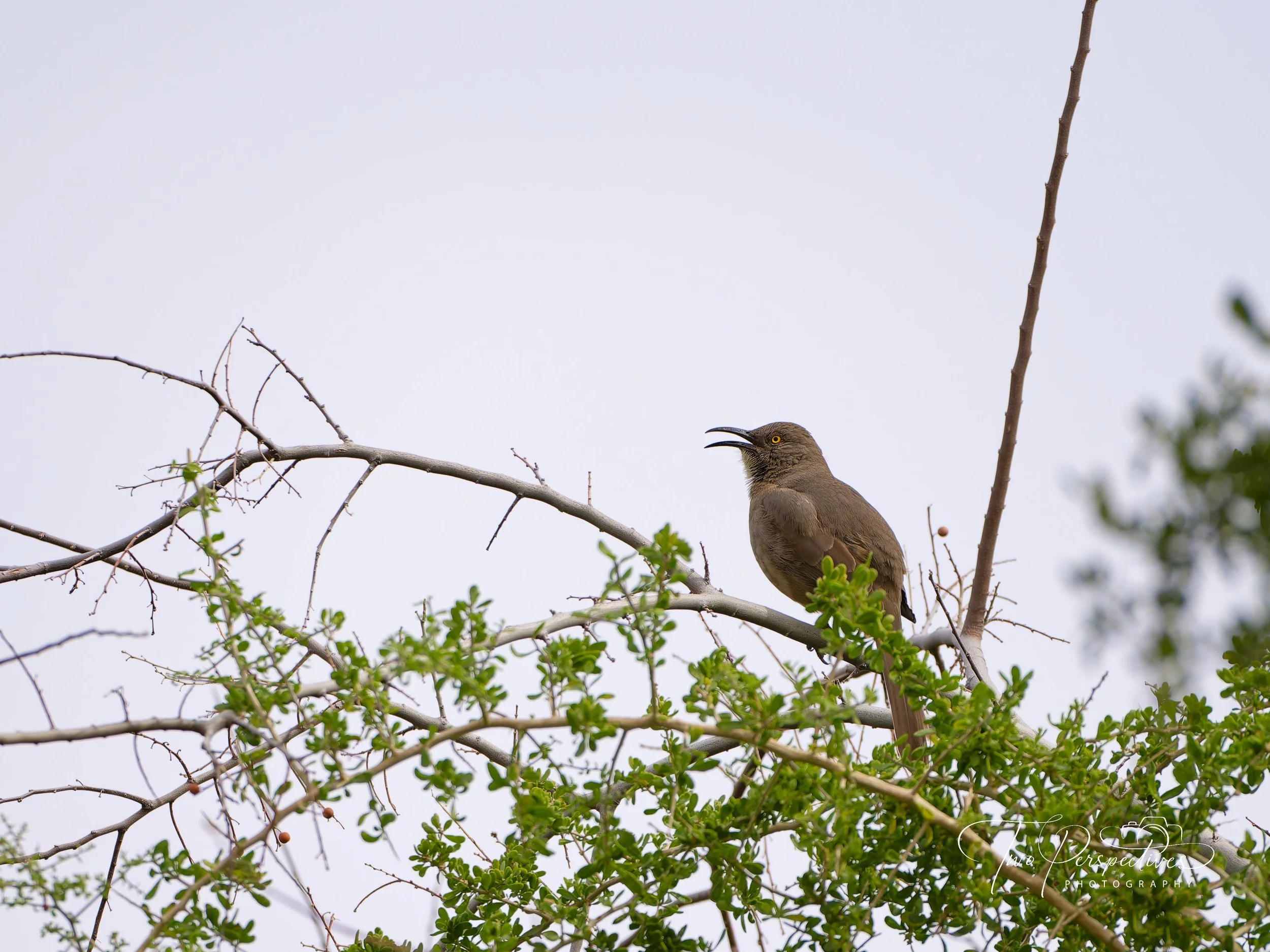
If you've spent a morning in the Sonoran Desert, you've heard it whether you knew the singer or not: a sharp, insistent whit-wheet! whistle, exactly like someone trying to get your attention across a parking lot. That's the calling card of the curve-billed thrasher, one of the desert's boldest, most charismatic, and most musically gifted residents. Gray-brown and long-tailed, with a gracefully down-curved bill and a pair of striking orange eyes, this bird carries itself with a kind of grumpy, confident authority, and it has a great deal to say.
A tireless singer with an endless songbook
The curve-billed thrasher may be the hardest-working voice in the desert. It belongs to the same family as mockingbirds and catbirds, the great mimics of the bird world, and it shares their remarkable gift: a vast, ever-changing repertoire of rich, warbling, musical phrases. In fact, it's often said that these thrashers never sing the same song twice, since their music follows no set pattern at all. They're frequently the very first birds to greet the morning and among the last to call out before dark, bookending the desert day in song.
Like its mimic cousins, the curve-billed thrasher is a talented impressionist. It will sometimes weave imitations of other birds into its own performance, borrowing snatches of song from its neighbors. Amusingly, the favor gets returned. Mockingbirds and starlings have been known to do such a perfect impression of the thrasher's famous whit-wheet that even experienced birders are fooled.
A home among the spines
Here's where the curve-billed thrasher reveals its genius. While most creatures give the wickedly barbed cholla cactus a wide berth, the thrasher calls it home, nesting in cholla around ninety percent of the time. It favors the chain-fruit and teddy bear cholla so faithfully that you could almost be forgiven for calling it the "cactus thrasher."
Deep within that maze of jumping spines, the pair builds a bulky cup nest of thorny twigs, somehow threading through the cactus without ever impaling themselves. The result is a near-impregnable fortress. Those needle-sharp spines keep out snakes, hawks, and ravens, creating a remarkably safe nursery for the thrasher's pretty, pale blue-green speckled eggs. It's a masterclass in turning the desert's most hostile plant into the safest possible cradle.
A desert bird that took to the city
For all its wild credentials, the curve-billed thrasher has proven wonderfully adaptable to life alongside us. It readily moves into suburbs and cities across the Southwest, with one simple condition: it needs cholla, or similar native vegetation, for its nest. Give it that, and it will happily settle into a backyard. Across Tucson and Phoenix, it's become one of the most common desert birds in town, boldly visiting feeders, where it can hold its own against smaller birds, foraging across yards, and filling neighborhoods with that unmistakable whistle. Plant a little of the right desert vegetation, and you may well earn yourself a thrasher.
A few more things to know
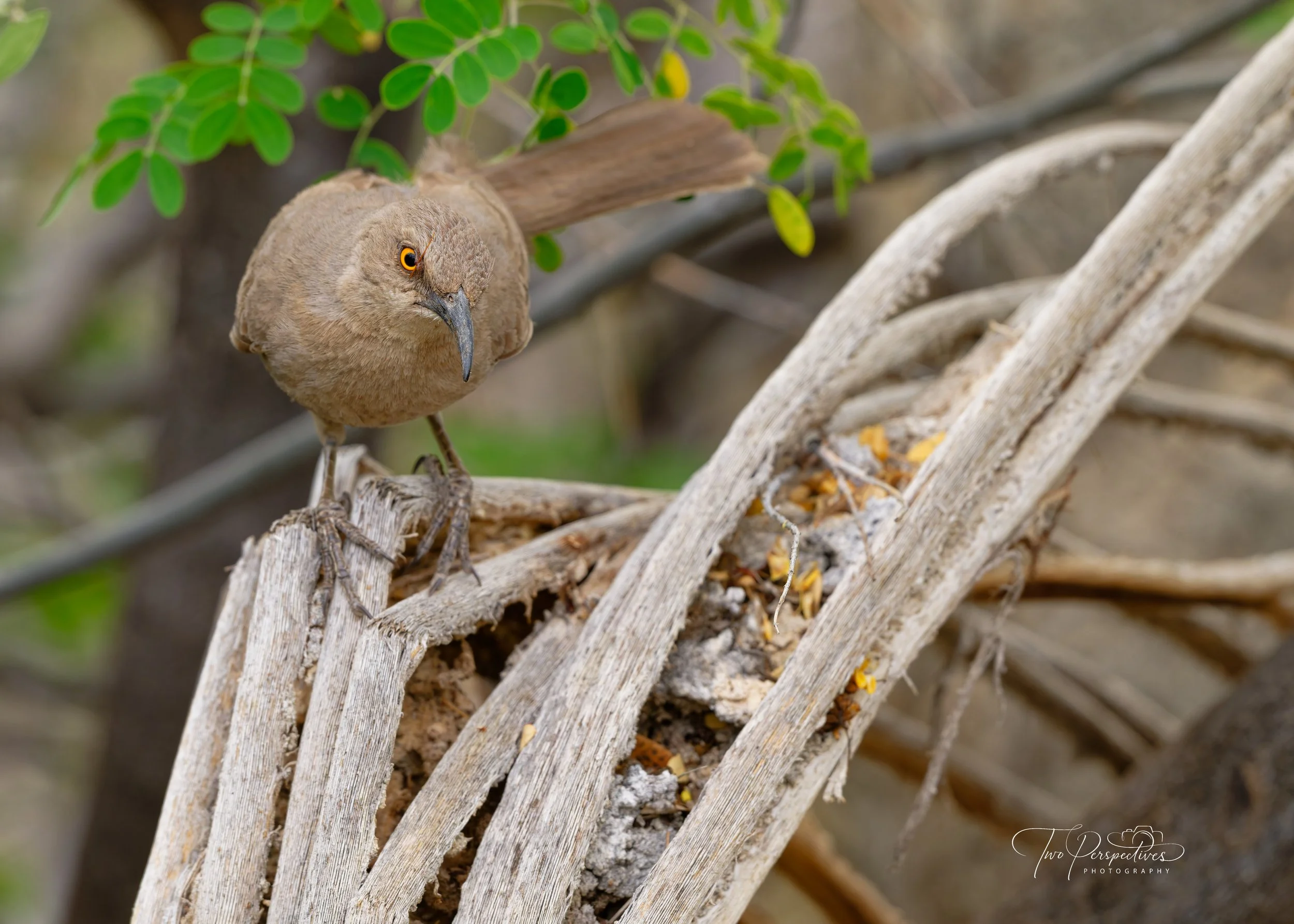
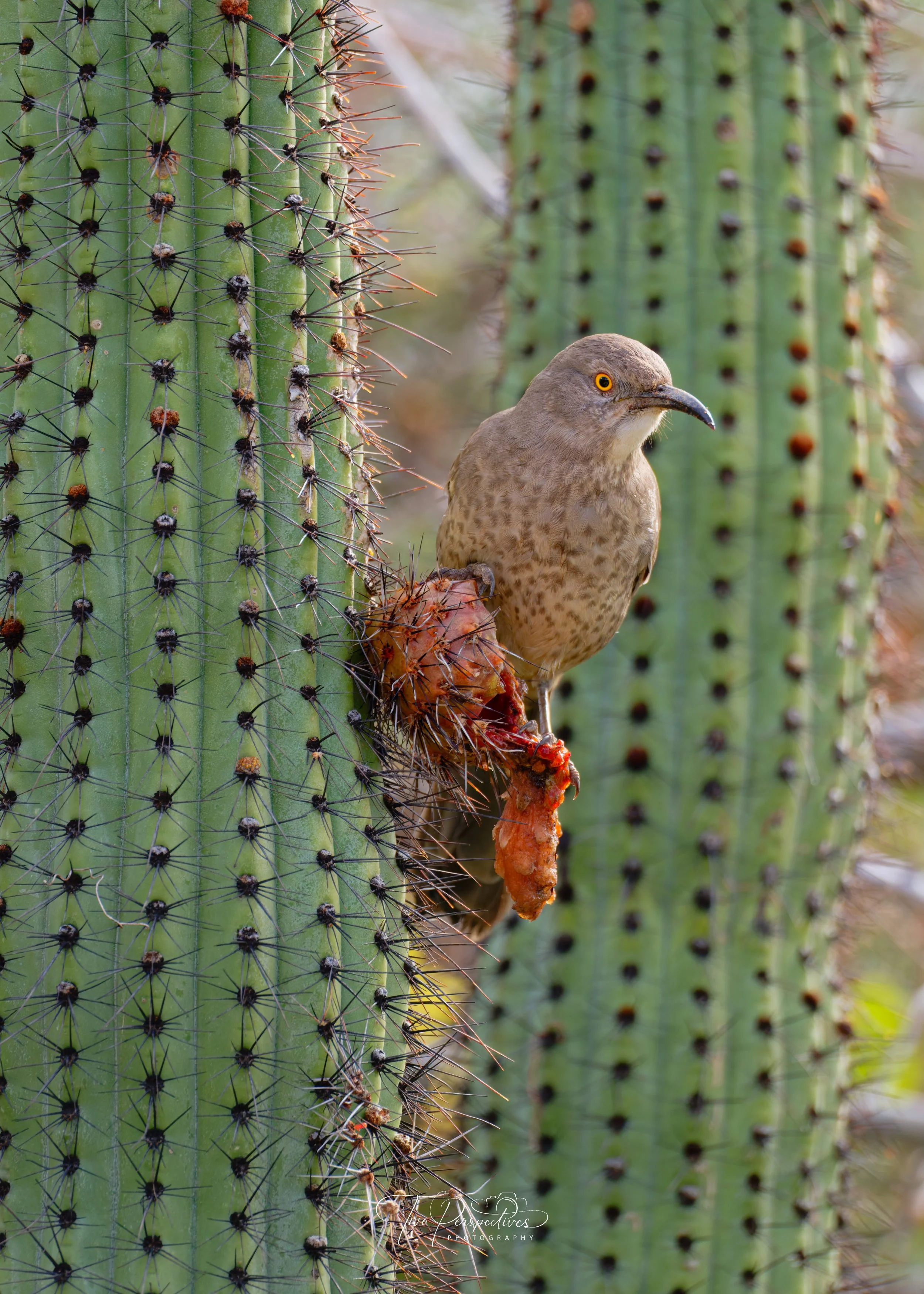
That elegant curved bill isn't just for looks, it's a tool. The thrasher uses it to sweep aside leaf litter and dig into the soil, hunting out the beetles, ants, grasshoppers, and other insects that make up much of its diet, along with berries and the fruit and seeds of cactus like prickly pear and saguaro. These are year-round desert residents, and a pair will often hold the same territory year after year, so the thrasher whistling in your neighborhood this season may well be the same one you hear next.
Where and when to find them
Curve-billed thrashers are easy to find all across Tucson and southeastern Arizona, especially anywhere cholla grows. Look for them perched up on a saguaro or cholla, belting out their song, or darting along the ground in quick, purposeful runs. Early morning and the hour before dusk are prime time, when they're at their most vocal. In the heat of the day, they retreat to the shade of a cactus or shrub.
Capturing them
The curve-billed thrasher is a rewarding subject: expressive, full of character, and obligingly bold, often perching right out in the open to sing. We love catching that fierce orange eye and the elegant line of the bill, or a parent slipping into a cholla nest. For a bird so common, it never fails to have personality to spare, a reminder that some of the desert's best characters are the ones singing right outside your door.