Anna's Hummingbird
Most hummingbirds are visitors, passing through on migration, spending a season, then gone. Not the Anna's. This rose-crowned little gem is Tucson's year-round hummingbird, the one holding court at backyard feeders in January, defending its territory in the heat of July, and filling the winter air with its scratchy, buzzing song when every other hummingbird has long since headed south. If you have a feeder up in Tucson, you almost certainly have an Anna's.
The winter dive
Here's what makes the Anna's Hummingbird genuinely remarkable, it nests in winter. While most birds are waiting out the cold, the male Anna's is already performing one of the most spectacular courtship displays in North America. He climbs high into the sky, up to 130 feet, then folds his wings and plunges straight down in a controlled dive, pulling out at the last instant with a sharp, explosive pop made entirely by his tail feathers. The female sits below, watching. In the right light, his head catches the sun and ignites into a blaze of rose-red iridescence, a tiny firework against a cold blue sky. It's one of the great unexpected wildlife spectacles of a Tucson winter morning.
Our wild neighbors
The Anna's Hummingbird has quietly become one of the great urban wildlife success stories of the American Southwest. A century ago, its range barely extended past coastal California. Backyard feeders and ornamental plantings changed all that, and the species has expanded steadily eastward and northward ever since. Tucson sits well within that expanded range now, and the Anna's has settled in completely, raising young in neighborhood trees, chasing rivals off garden feeders, and treating suburban yards as entirely acceptable habitat. They're territorial and vocal about it. That scratchy, buzzing, endlessly varied song coming from the top of your ocotillo is almost certainly an Anna's announcing that this yard is taken.
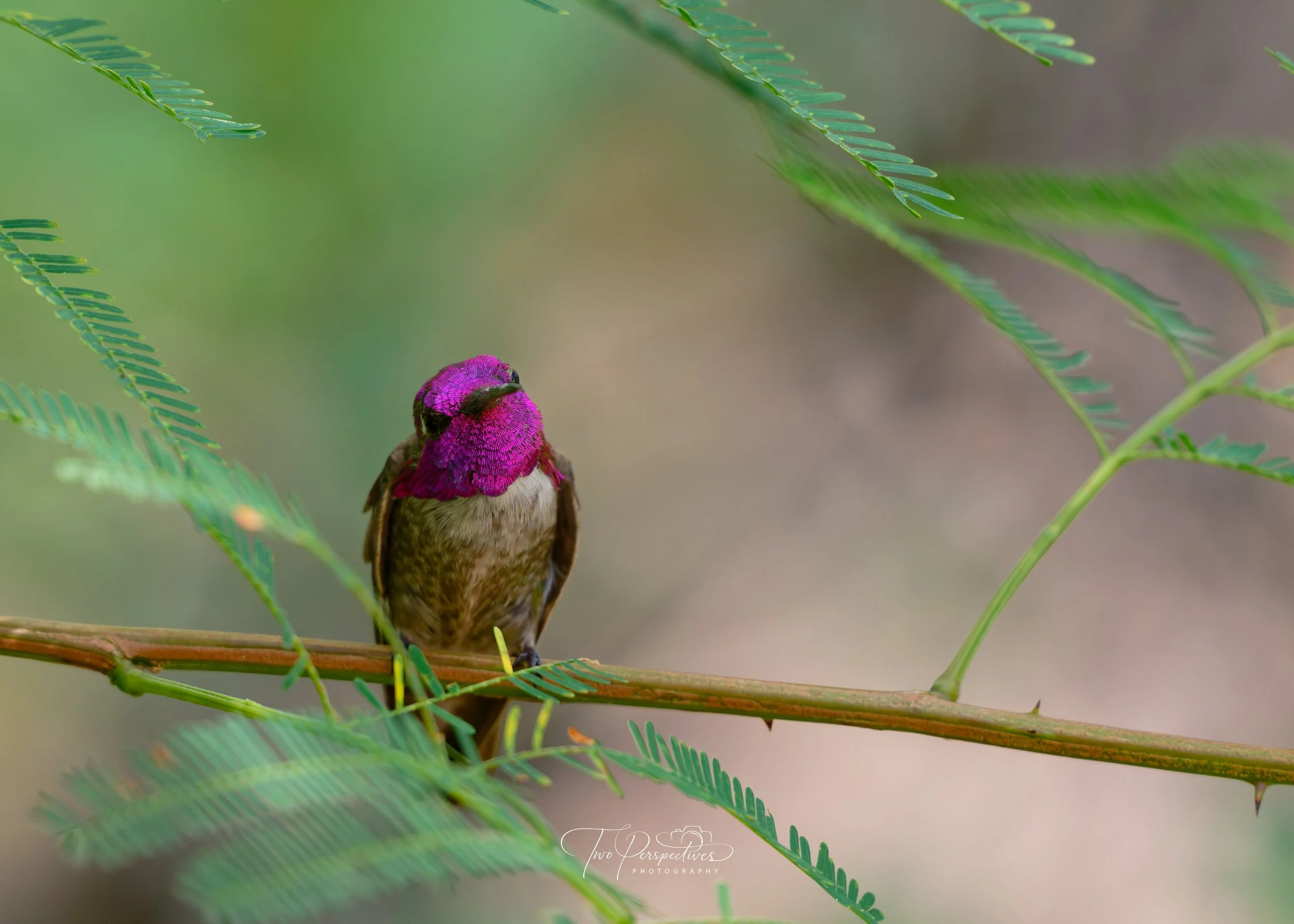
Male Anna's Hummingbird
A few fun facts
To survive cold desert nights Anna's Hummingbirds enter a state called torpor, a deep energy-saving sleep where their heart rate and body temperature drop dramatically. They're essentially hibernating until morning.
Their wings beat around 40 to 50 times per second in normal flight, and even faster during the courtship dive.
The male's rose-red head is not pigment, it's structural iridescence. The color appears and disappears depending on the angle of the light, which is part of what makes the dive display so dramatic.
They're one of the only hummingbirds known to sing, producing a long, complex, scratchy song unlike anything else in the yard.
A single Anna's Hummingbird can visit more than a thousand flowers in a day.
Attracting them
Anna's are the easiest of our hummingbirds to attract and the most reliable to keep. A clean feeder with fresh sugar water (four parts water to one part plain white sugar, no red dye needed) is the starting point. Native tubular flowers, penstemon, salvia, desert willow, and chuparosa, give them natural nectar sources and the insects they need for protein. They're territorial enough that one feeder may spark arguments; two or three placed out of sight of each other gives everyone a chance.
One important note: if you put up a feeder, you must keep it clean and the nectar fresh. Stale or fermented sugar water can cause candidiasis, a fungal infection that causes swelling of the tongue and leaves hummingbirds unable to eat. In southern Arizona's heat, that means changing the nectar more often than most people realize. A rough guide: at 90°F and above, change it every day. At 80 to 89°F, every two days. At 70 to 79°F, every three days. No matter the temperature, change it every five days at minimum. A feeder that isn't maintained is worse than no feeder at all.
Where and when to find them
All year, all over Tucson. Backyard feeders are the easiest bet. Look for the male perching high on an exposed branch or wire above his territory, singing, then launching into a chase when a rival wanders too close. The Arizona Sonora Desert Museum, Tohono Chul, and the Tucson Botanical Gardens all host them reliably. During the monsoon season, numbers swell as other species move through, making late July through September a spectacular time to watch the feeder drama unfold.
Capturing them
The Anna's is a demanding and endlessly rewarding subject. That rose-pink head exists in a narrow window of angle and light, one degree off and it reads as dark brown; catch it right and it blazes. We love working the local blooms in early morning light, watching for the angle that ignites the gorget, and trying to freeze those wings in the middle of a hover. Catching the male mid-dive, a tiny streaking comet against an open sky, is the dream shot. They're bold enough to investigate a lens at close range, which makes for intimate portraits that larger subjects rarely allow.