Bridled Titmouse
You hear them before you see them. A chattering, fussing little flock moving through the oaks, and suddenly there one is, a bird about the size of a sparrow but with a face that stops you cold. The Bridled Titmouse carries one of the most distinctive patterns in all of North American birdlife: a swirling black-and-white face design that looks like it was painted on with a fine brush. If you spend any time in the oak and pine-oak canyons of southeastern Arizona, you will meet this bird. And once you do, you will not forget it.
That face
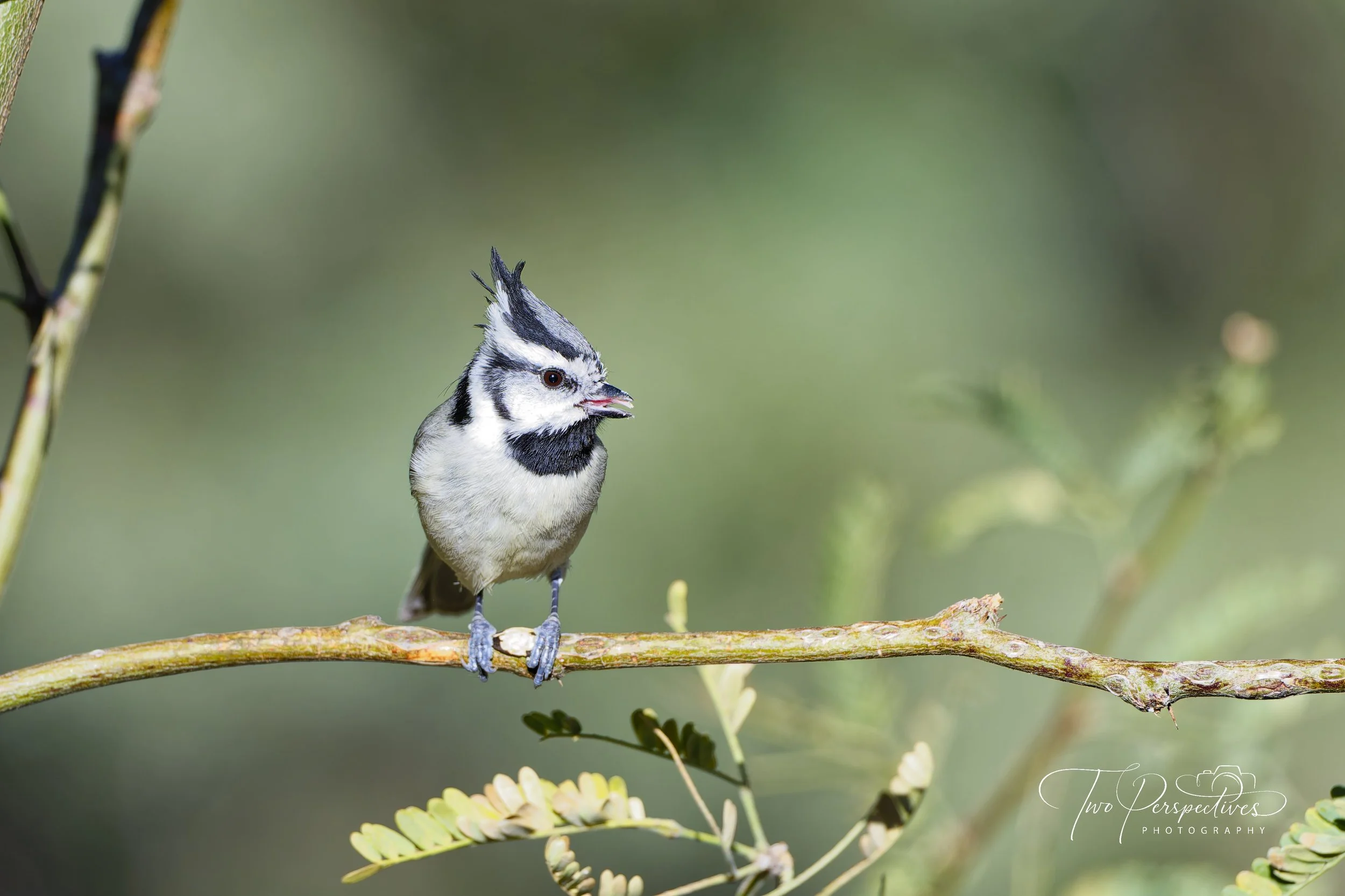
The Bridled Titmouse (Baeolophus wollweberi) is a small bird with a lot going on in its appearance. Audubon describes it plainly: the Bridled Titmouse has a black-and-white "bridle" pattern on its face, along with a gray-and-black crest. Sexes look alike, so you do not need to guess who is who. The body is overall gray, the underparts pale, nothing flashy below the neck. But from the neck up, this bird is immediately recognizable. The name comes from the face pattern itself, which resembles a bridle. The black lines running across the white face create that same looping, structured look.
Size-wise, you are looking at a bird that runs 5 to 6 inches long with a wingspan of 7 to 8 inches and weighs somewhere between 0.4 and 0.6 ounces. That is a very small bird. The crest is shared with other titmice and is often raised when the bird is alert or agitated, which around a flock of chattering birds seems to be most of the time. Audubon notes the species is sometimes confused with the Mountain Chickadee, and it is easy to see why: the black-and-white face, the active foraging behavior, even the calls can echo a chickadee. But once you know the bridle pattern, there is no mistaking one.
Our wild neighbors
In the United States, the Bridled Titmouse occupies one of the smallest ranges of any bird you are likely to encounter regularly. It is essentially a southeastern Arizona bird with a small extension into adjacent New Mexico. That is it. Within its limited US range, Audubon describes it as very common with numbers apparently stable. Cornell describes it as "a specialty of the middle-elevation forests of the southwestern U.S. and adjacent Mexico." Outside of those mountain sky islands, you simply will not find this bird.
Habitat matters a great deal for this species. Cornell notes that Bridled Titmice inhabit mountain ranges, mostly in mature woodlands where oaks, or a mixture of oaks, pines, and junipers, predominate. Key tree species in Arizona include Emory oak, Arizona white oak, alligator juniper, Chihuahua pine, and Apache pine. They will also use streamside corridors with sycamores, cottonwoods, and willows. In the US, they breed at elevations as low as 5,000 feet but will drop to lower elevations in winter. The Audubon Field Guide describes their habitat as "oak and sycamore canyons, pine-oak woods," and if you have spent time in Madera Canyon, the Huachuca Mountains, or the Chiricahuas, you know exactly the kind of place they mean.
Behavior is where these birds really show their character. Audubon says they move in small flocks through the oaks, chattering constantly, searching branches for insects. Cornell adds that Bridled Titmice are often at the center of mixed-species foraging flocks that can include chickadees, kinglets, warblers, vireos, tanagers, and nuthatches. They also serve as sentinels in those flocks, alerting other species to danger with harsh calls. That is a meaningful role in a woodland community. They are not just tagging along. Audubon notes the species is mostly a permanent resident, though small flocks regularly move to lower elevations in winter.
A few fun facts
The Bridled Titmouse forages by hanging upside-down from the outer tips of branches to reach insects on the undersides of leaves. Cornell describes this as suspending themselves briefly to reach prey on the tips of outer branches. This chickadee-style acrobatics is a signature move.
Cornell notes that the Bridled Titmouse is unique among North American titmice and chickadees in having helpers at the nest. A third adult, often a male, sometimes joins a breeding pair to help feed and care for the young.
The pair bond is strong. Cornell documents that Bridled Titmice form monogamous pairs that stay together year-round. In spring, males feed their partners in a behavior called courtship feeding, and the females respond by quivering their wings and begging like nestlings.
Diet goes beyond insects. Cornell confirms they eat acorns, break open plant galls to reach larvae, and prey on beetles, bugs, caterpillars, leafhoppers, and spiders.
One of their common calls is a variant of the familiar chick-a-dee call. Audubon notes this directly. If you are in the right habitat and hear something that sounds like a chickadee but slightly different, look up.
Where and when to find them
Southeastern Arizona is where you want to be. The sky island mountain ranges are the core of their US range: Madera Canyon in the Santa Rita Mountains, the Huachuca Mountains near Sierra Vista, and the Chiricahua Mountains to the east are all reliable sites. Look for them in the mid-elevation oak woodland, particularly in canyons where oaks mix with Arizona sycamore. They are year-round residents, so you do not need to time your trip around migration. Winter often brings them a bit lower in elevation, which can actually make them easier to find as they concentrate in streamside cottonwood and willow corridors below the main oak zone.
The best strategy is to listen first. Small mixed flocks move through the oaks with a fair amount of noise, and the Bridled Titmouse contributes its share. Once you hear the chattering and locate the flock, you will often find Bridled Titmice in the mix alongside Mexican Chickadees, Ruby-crowned Kinglets, and various warblers. Being part of those mixed flocks is their habit, and the flocks move steadily, so you will have to keep up.
Capturing them
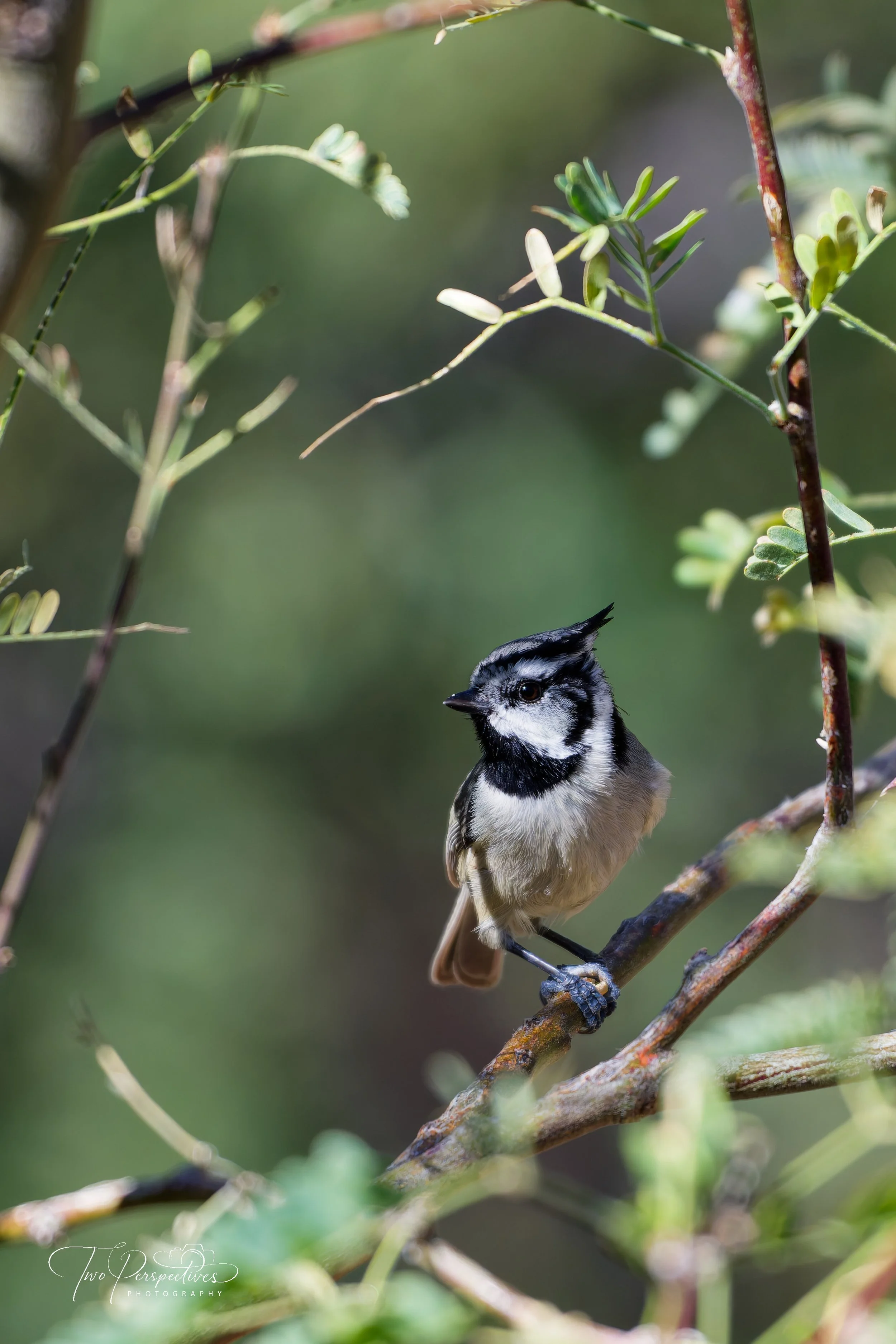
Photography on this species is a real challenge and honestly a lot of fun. The birds are small, faster than they look, and they move constantly through cluttered oak canopy that creates difficult light conditions. You will deal with dappled shade, backlit branches, and a subject that almost never sits still for more than a second or two before flitting to the next branch.
Positioning yourself near a known mixed flock and waiting, rather than chasing, often works better than trying to follow them through the understory. The flocks move in a general direction, so you can sometimes get ahead of them and let them come to you. The upside-down foraging pose is worth the patience to wait for. When a Bridled Titmouse swings itself below a branch to inspect the underside of a leaf, it is the kind of image that shows exactly what this bird is and what it does. That is always the shot we are chasing.