Wild Turkey
Most people's mental image of a turkey involves a grocery store. The bird in the wild is something else entirely. Wild turkeys are large, sharp-eyed, and surprisingly fast on their feet. They can also fly, which catches a lot of people off guard. When you hear one gobble from inside a pine canyon in the Chiricahuas on a spring morning, it sounds like nothing else out there, and it carries farther than you'd expect.
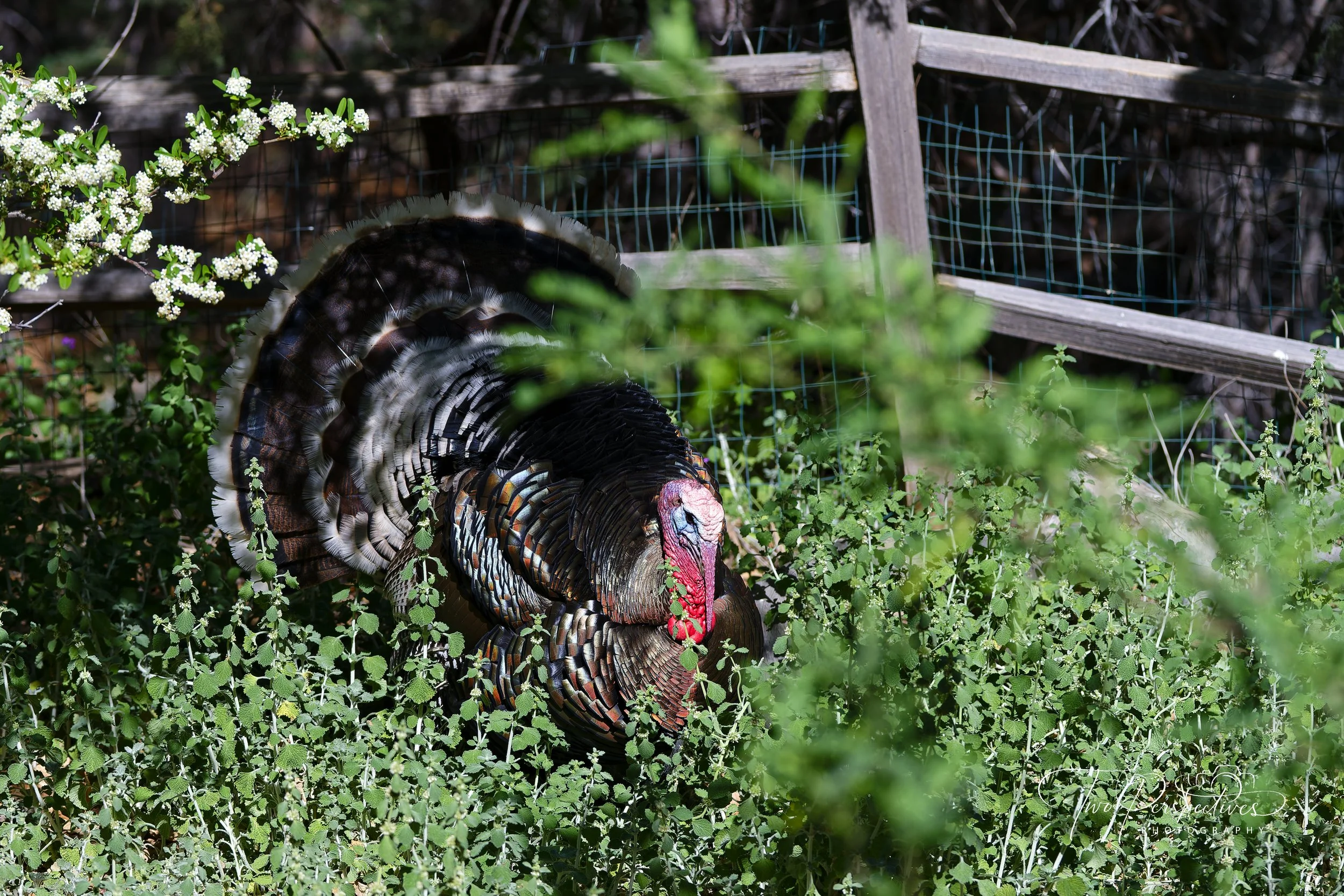
Big bird, not what you'd picture
The Wild Turkey (Meleagris gallopavo) is one of the largest flying birds in North America. Adult males, called toms or gobblers, typically weigh between 11 and 24 pounds and stand around three and a half feet tall with a wingspan close to four and a half feet. The record-sized tom, according to the National Wild Turkey Federation, weighed just over 37 pounds. Females, called hens, are noticeably smaller, usually running between 5 and 12 pounds.
Males in full display are genuinely striking birds. The body feathers have a coppery bronze iridescence that shifts color in sunlight. The wings are dark with white barring. The tail fans out wide in a semicircle during courtship, and that distinctive naked head cycles through red, white, and blue depending on the bird's mood. An excited tom's head goes nearly white. There is a fleshy growth called a snood that hangs over the bill, wattles of skin at the throat, and bumpy caruncles across the face. Males also typically carry a "beard," a tuft of coarse bristle-like feathers growing from the center of the breast. A wild turkey in full strut is a completely different animal from anything you'd see at Thanksgiving.
Hens are brown and gray overall, patterned to blend into the forest floor. They are subtler birds, but just as capable. Wild turkeys carry somewhere between 5,000 and 6,000 feathers in total.
Our wild neighbors
Wild turkeys are native to North America and have one of the more interesting conservation comeback stories in the country. Their numbers had dropped sharply by the early 1900s due to overhunting and habitat loss. Conservation and reintroduction efforts reversed that, and Audubon estimates the current population at roughly 6.9 million birds. They are now listed as Least Concern by the IUCN.
In southern Arizona, the turkey you are most likely to encounter in the sky islands and southeastern mountain ranges is the Gould's Wild Turkey (Meleagris gallopavo mexicana). Gould's is the largest of the six recognized subspecies and is native to the mountains of northwestern Mexico and the southernmost reaches of Arizona and New Mexico. In the United States, this subspecies is rare and protected. The places near Tucson where you have the best chance of running into them include Madera Canyon in the Santa Ritas, the Chiricahua Mountains around Cave Creek Canyon and Turkey Creek, the Huachuca Mountains around Ramsey Canyon and the Coronado National Memorial, and higher elevations in the Catalinas. Merriam's Wild Turkey (Meleagris gallopavo merriami), a separate subspecies adapted to ponderosa pine country, ranges through central and northern Arizona into the Rocky Mountain states.
Turkeys thrive where woodland and open clearings mix together. Acorns are a core food source, so stands of oak pull them in reliably. They forage on the ground, scratching through leaf litter for acorns, seeds, berries, insects, and the occasional small reptile or amphibian. They are not migratory, though they may move around seasonally. At night, they roost in tall trees, which is how they avoid most ground predators.
A few fun facts
A tom's gobble can be heard up to a mile away. It is one of the more impressive bird sounds in North America, especially when it rolls through a mountain canyon at dawn.
Wild turkeys can fly strongly. The domestic turkey, bred for weight gain, cannot. The wild bird is a completely different animal.
Male turkeys sometimes court females in pairs. Research published in the journal Nature found that these pairs are typically close relatives, and the less dominant male benefits by helping a relative pass on shared genetic material. It is a well-documented example of kin selection in birds.
Wild turkeys carry roughly 5,000 to 6,000 feathers, a count that includes the large body feathers as well as the smaller down and contour feathers underneath.
Where and when to find them
In the mountain ranges around Tucson, spring is the most active season for turkeys. Toms start gobbling in March and April, which is when they are easiest to locate by sound. Madera Canyon in the Santa Ritas is one of the most reliable spots near Tucson. The road up the canyon passes through oak and pine woodland that turkeys use regularly. Cave Creek Canyon in the Chiricahuas is another strong location, and turkeys there show up at the feeders and campground areas with some regularity. The Coronado National Memorial in the Huachucas also holds a consistent population.
Look for them along roadsides and open forest clearings in the early morning and late afternoon. That is when they forage most actively. In the heat of midday they tend to move into shade and become harder to find.
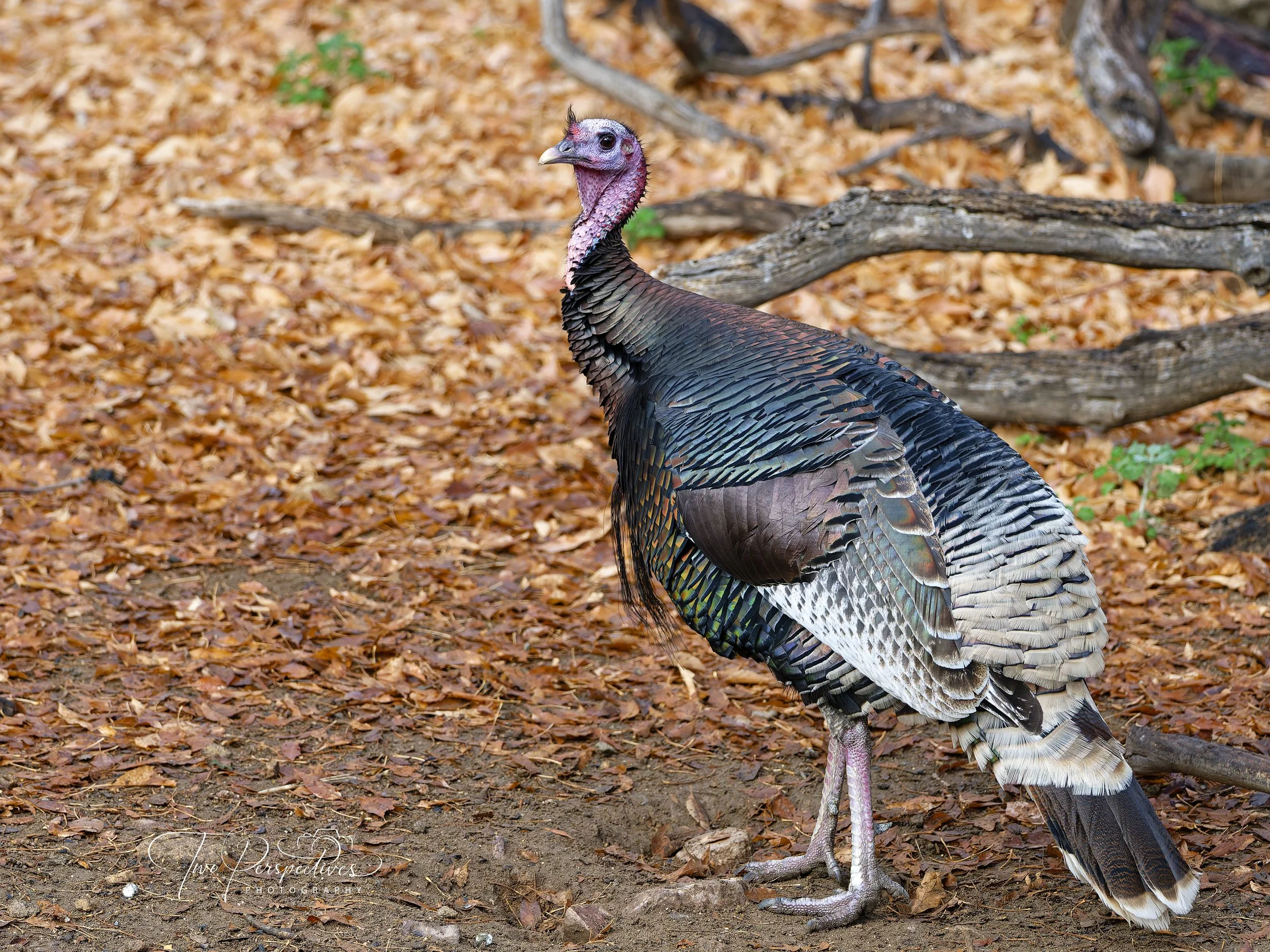
Capturing them
Turkeys are large, which makes them easier to find than a lot of birds, but their wariness makes a close approach genuinely challenging. They have excellent eyesight, good peripheral vision, and they move quickly when they decide to leave. Getting within camera range without spooking them takes patience and attention to your own movement and silhouette.
The best light for photography is the first couple hours of morning. That is when toms are most likely to be actively strutting and displaying, and the angle of light brings out the iridescence in the feathers in a way that midday sun simply does not. A longer lens helps maintain distance. Madera Canyon and Cave Creek Canyon both offer road-accessible spots where birds are habituated enough to tolerate a patient observer with a camera who stays inside a vehicle or moves slowly. The full-display strut shot is the one to wait for, and it is worth the time.